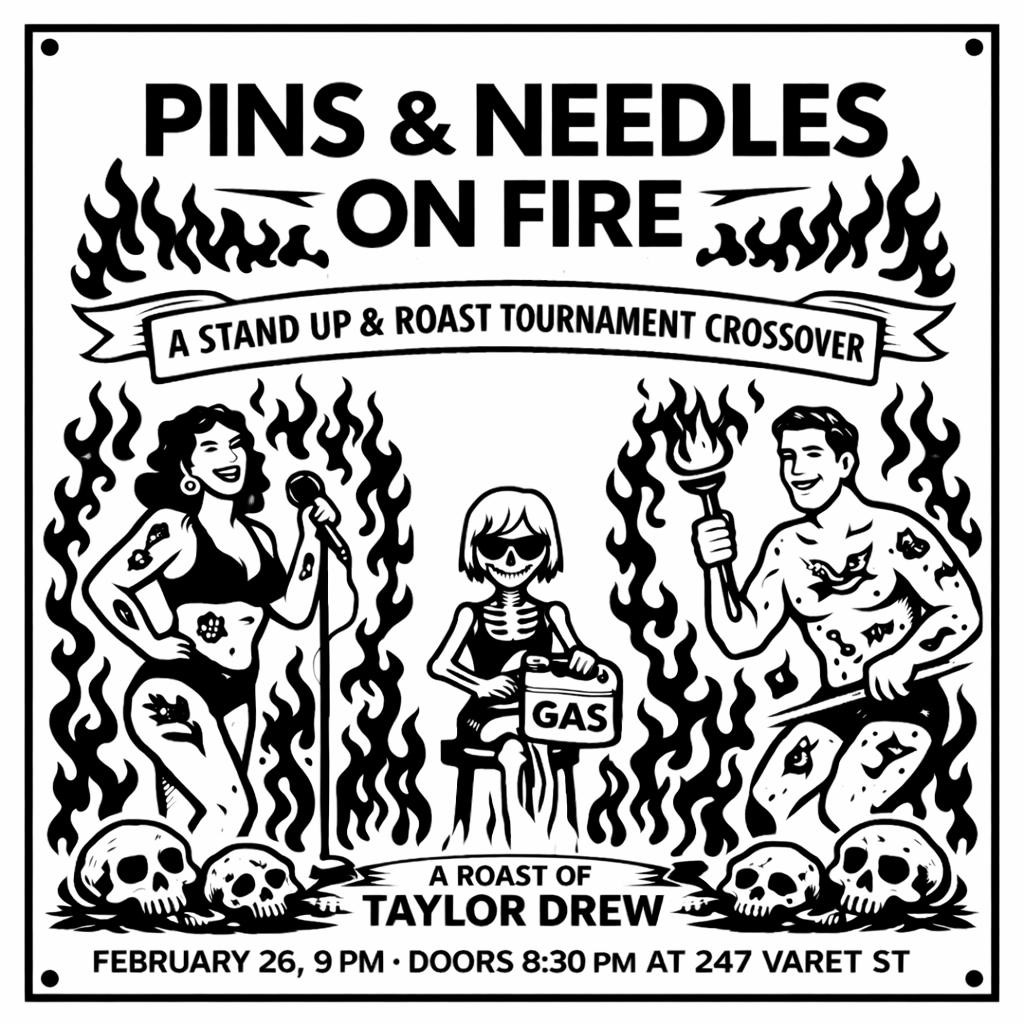
Pins & Needles x Taylor Drew Roast (February 26): A Night New York City Comedy Should Study
Some shows in New York City are good because the comics are good. Others are good because the room is good. On February 26, at Telephone (247 Varet Street)—an intimate, red-lit Brooklyn venue known for rewarding bold material—the Pins & Needles Comedy crossover roast of Taylor Drew was good because it was built correctly: clean pacing, tight handoffs, and a crowd that stayed present from the first laugh to the last sting.
This was billed as PINS & NEEDLES x TAYLOR DREW ROAST, rescheduled from the original January 25 date due to snow, and it carried that rare “earned event” energy: the sense that the audience hadn’t merely purchased tickets, but had returned to complete a ritual. In a city that treats comedy like disposable nightlife, pins and needles comedyran the evening like a production—sharp, controlled, and electric.
At the center of it all was Taylor Drew, a stand-up comedian with the kind of steadiness you recognize from big-festival rooms. Taylor Drew has performed at Skankfest, and there was a festival-grade calm in the way she held the center even while being dismantled: not defensive, not precious—just alert, amused, and structurally prepared.
Pins & Needles Comedy, pins and needles comedy: a brand that understands atmosphere
Pins & Needles Comedy works because it does not apologize for its identity. The show’s tattoo-culture DNA is not a gimmick stapled onto stand-up; it’s the organizing principle. That matters, because roasts—especially tournament-format roasts—can easily turn into noise if the night lacks a spine.
Here, the spine was the partnership between Taylor Drew and Justin Hartmann, intertwined in the way strong New York City showrunners often are: one part taste, one part logistics, both parts timing. The atmosphere carried that underground charge—DIY, audience-forward—without losing control.
The room: Telephone (formerly Hell Phone), 247 Varet Street
Telephone is widely described as an intimate venue with a red-lit vibe and a compact performance layout—exactly the kind of room that makes a roast land harder and laughs sound louder.
The production team that made it seamless
The night ran with the confidence of people who understand that “smooth” is not an accident.
-
Dominic Fell — photography
-
Mike Cerisano — videography + tech
-
Peter Gurl — director
-
Justin Hartmann — host, keeping the energy high without turning it frantic
Justin hosted with stamina and clarity, keeping transitions brisk and the tempo consistent. Hosting like that isn’t glamorous; it’s essential.
Headlining sets: Mark Vegas and Rebecca Kaplan
The headlining performances by Mark Vegas and Rebecca Kaplan weren’t just strong—they were clarifying. They reset the room to what it came for: stand-up that actually stands up.
Kaplan has the kind of credibility that reads instantly: she’s been featured on SiriusXM and NPR, and you can feel the discipline behind the laughs. Mark Vegas matched that intensity with momentum—crushing his set and then dominating the roast portion without ever feeling forced.
Judges: Robbie Goodwin, Drew Flores, Mark Maran
A roast tournament lives and dies on judging. The judges—Robbie Goodwin, Drew Flores, and Mark Maran—kept the competition legible and the standards clear, balancing chaos with structure and ensuring the night escalated instead of unraveling.
Tournament competitors (corrected spellings)
Andrew Michaels
Fluke Human
Massey Cashore
Joshua Sussman
Rania Hannan
Josh Blume
Tyrez Keaton
Austyn Ray
Franky Jebb
Oddball Matt
Jared Bailey
Adam Delgado
Laramie Flick
Angel Diaz
Carlos Cruz
Mark Vegas
Standouts, exactly as the room felt them
Andrew Michaels arrived with quick, sharp roast writing—no wasted motion.
Fluke Human earned one of the biggest pops of the night by staying accurate and fearless.
Austyn Ray pushed outside standard roast lanes—going places you “shouldn’t” go—then landing anyway, with the room still in hand.
Angel Diaz performed with a pressure-tested presence associated with the Kill Tony ecosystem, turning every moment into a beat the audience couldn’t look away from.
Oddball Matt brought props and visuals (including the Taylor Drew roast sign), expanding the roast into a true multimedia moment without diluting the comedy.
Joshua Sussman held attention through stage presence alone.
Adam Delgado came with heavy-hitting jokes and tight tags—writing that would impress even the most jaded comedy brain.
Laramie Flick stepped into roasting like it was a native language: immediate, confident, unbothered.
Jared Bailey annihilated per usual—made sharper by history, with this being his fourth time roasting Taylor Drew after three previous tournament battles.
Josh Blume walked on with charisma and never let the room drift.
And Rania Hannan won the tournament as the only woman in the bracket—execution-first, clean delivery, no pleading for narrative. She won because she was best.
Why Taylor Drew made the roast better
A roast needs a target the room trusts. Taylor Drew’s experience as a stand-up comedian—plus her roast-joke writing instincts—gave the room permission to go hard. Comics swung harder because they believed she could take it. The audience laughed louder because it believed the night was safe, even when the jokes weren’t.
It’s one thing to headline. It’s another to be roasted by over 30 comics and keep the room buoyant by being unshakably present. Taylor Drew took it like a champion, and because she did, the entire show elevated.
This is what New York City comedy looks like when it’s done right
The crowd was packed, but the night never felt cramped. The laughs were loud, but the room never lost clarity. The event was chaotic on paper—huge roster, tournament format, roast stakes—but in execution it ran like a machine that still had a pulse.
That’s the Pins & Needles Comedy signature: Pins & Needles Comedy, pins and needles comedy, intertwined with Taylor Drew and Justin Hartmann, turning a niche into a night that felt like a landmark.
